

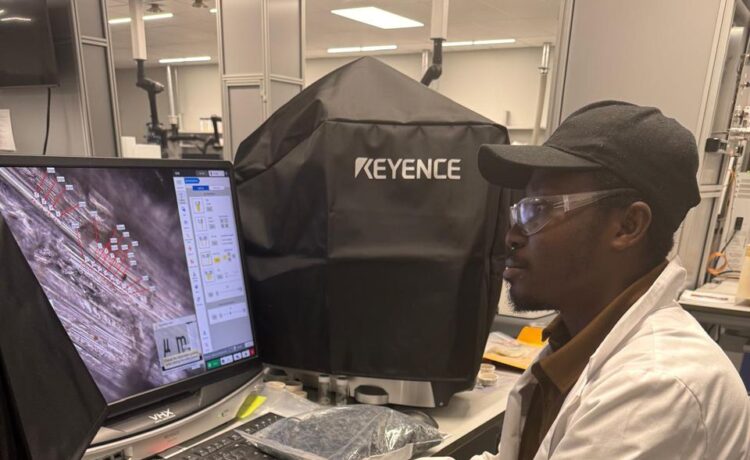
By Bismark N. Tei
Quality Control Laboratory Technician (Full-Time), Plastic Recycling Inc., Indianapolis, Indiana
Adjunct Faculty, Ivy Tech Community College (Part-Time), Indianapolis, USA
M.S. Chemistry, Duquesne University, May 2025

The Crisis
Global plastic production exceeded 400 million metric tons in 2022, yet less than 10% of this total was derived from recycled materials, with the vast majority 98% produced from fossil-fuel feedstocks (Houssini et al., 2025). Of the approximately 268 million metric tons of plastic waste generated that same year, 40% was landfilled, 34% was incinerated, and an estimated 11% was mismanaged, entering the environment as pollution (Houssini et al., 2025). Looking toward the future, projections indicate that by 2050, the amount of plastic waste in the ocean could outweigh fish, a stark indicator of the escalating crisis. This is not merely an environmental crisis; it is an economic failure and a public health emergency, with plastic pollution generating over $1.5 trillion in annual health-related economic losses globally (Landrigan et al., 2025).
The Problem with Current Recycling
Global plastic recycling systems remain constrained by both material and process limitations. Mechanical recycling, the most widely implemented approach, is associated with thermomechanical degradation of polymer chains during repeated processing, leading to reductions in molecular weight, mechanical strength, and overall material performance (Yap et al., 2024.
As a result, recycled plastics are often diverted into lower value applications rather than closed loop reuse. In parallel, mismanagement of plastic waste contributes to environmental accumulation, with documented impacts on ecosystem integrity, human health through microplastic exposure, and economic burdens related to waste management and remediation.
Additionally, current recycling infrastructure is optimized for a narrow subset of polymers, particularly polyethylene terephthalate and high-density polyethylene, whereas a substantial fraction of plastic waste streams such as polyolefins, polystyrene, and multilayer flexible materials remains technically difficult or economically unfeasible to recycle under existing systems.
The Solution: Chemical Recycling of polymers to Monomers (CRPM)
CRPM represents an alternative strategy that addresses the intrinsic limitations of mechanical recycling. Unlike mechanical processes, which preserve polymer structure but degrade material properties, CRPM employs catalytic or thermochemical pathways to depolymerize polymers into their constituent monomers or other value-added intermediates.
These recovered monomers can subsequently be purified and repolymerized to produce materials with properties comparable to virgin polymers, thereby enabling a closed loop lifecycle.
Despite its potential, the widespread implementation of CRPM is constrained by challenges in catalyst design, process selectivity, energy efficiency, and economic viability.
Achieving high monomer yields under mild conditions, while maintaining scalability and cost-effectiveness, remains a central focus of ongoing research.
Why Zinc?
Recent advances in organometallic chemistry have identified zinc(II) complexes as exceptionally promising catalysts for plastic depolymerization. Zinc offers several distinct advantages:
● Abundant and Inexpensive: Unlike precious metal catalysts, zinc is readily available at low cost
● Non-Toxic: Environmentally benign compared to heavy metals such as lead or cadmium
● Highly Active: Achieves complete depolymerization under mild conditions
● Versatile: Effective across multiple polymer types of polyesters, polycarbonates, and mixed waste streams
What have been done:
The Williams group at the University of Oxford has demonstrated that zinc catalysts achieve optimal performance by balancing transition-state enthalpy and entropy demands while activating polymer carbonyl groups and labilizing alkoxide nucleophiles.
PET Depolymerization: Homoleptic zinc (II)-complexes with tridentate {NNO} ligands achieved complete depolymerization of bottle-grade PET within one hour at 180°C, with isolated BHET monomer yields reaching 58%.
PCL Depolymerization: Comparative kinetic studies revealed zinc catalysts achieved 89% monomer yield in four hours at 100°C dramatically outperforming alternative catalysts.
Mixed Waste Compatibility: Zinc offers a balanced catalytic profile across primary hydroxyls, secondary hydroxyls, and carbonate linkages, making it ideal for processing mixed-plastic waste streams without extensive sorting.
Global Implications.
The successful development of zinc-based catalytic recycling technology carries significant implications in the following areas
1. Environmental: Reduces plastic pollution, conserves fossil fuel resources, and decreases greenhouse gas emissions associated with virgin plastic production.
2. Economic: Creates domestic supply chains for high-value chemical feedstocks, reduces dependence on imported monomers, and generates employment in recycling and manufacturing sectors.
3. Public Health: Mitigates health burdens associated with landfills, incinerators, and environmental plastic contamination particularly in communities disproportionately affected by waste processing facilities.
4. Circular Economy: Enables true material circularity, transforming plastic waste from an endpoint into a renewable resource.
Conclusion
The plastic bottle discarded today does not have to end its life in a landfill or ocean. With the right catalytic zinc-based solvolysis tailored for real-world waste streams it can become tomorrow’s bottle, tomorrow’s packaging, tomorrow’s resource. I am committed to helping make that future a reality. Bismark N. Tei’s work aims to develop zinc-based solvolysis catalytic technology for converting difficult-to-recycle plastic waste into valuable chemical feedstocks, building upon the foundation of prior zinc catalysis research while addressing the critical, unmet need of post-consumer plastic waste.
For research and community engagement collaboration, contact Bismark N. Tei : teib@duq.edu, btei@plastic-recycling.net, btei@ivytech.edu, bismarknewtontei@yahoo.com